Pick Duolingo if you want a free or cheap daily habit in almost any language. Pick Speak if your real goal is to talk, you learn one of its seven languages, and you are happy to pay more for it.
Duolingo
- Learners
- 58.7M every day
- App Store
- 4.7 5.5M ratings
- Google Play
- 4.7 49M reviews
- Languages
- 40+ courses
Speak
- Learners
- 15M+ downloads
- App Store
- 4.8 61K ratings
- Google Play
- 4.7 123K reviews
- Languages
- 7 6 + English
Duolingo daily active users from its Q2 2026 shareholder letter [3]. Speak's download count is the company's own figure [7]. Store ratings (number of ratings) checked in September 2026 [1][2][5][6].
Most people who search this have the same problem. They have a long Duolingo streak and still freeze when someone speaks to them. Speak promises to fix exactly that, but it costs more and teaches far fewer languages.
We used both apps side by side, on their paid plans, and looked at the things that decide whether you will speak in six months: how much you talk, how lessons are built, and how good the feedback on your voice is.
The short answer
You want a daily habit and a free way to start
Short games, streaks and 40+ languages. Light on real speaking.
You want to talk from day one in one of its 7 languages
Spoken lessons, roleplays and an AI tutor. Pricier, and fewer languages.
How they score
We scored each app out of 10 on the things that matter most once the novelty wears off. Duolingo wins on habit, language choice and value. Speak wins on speaking, feedback on your voice and review of phrases.
Our scores after using both apps on paid plans in 2026. Higher is better.
DuolingoSpeak
Building a daily habit
Speaking practice
Feedback on your pronunciation
Beginner friendly
Keeping and reviewing phrases
Value for money
Language choice
How we tested
We used Duolingo Super and Speak Premium on iPhone and Android over several weeks in 2026, and did the same things in both: the first lesson, a week of daily sessions, and a few conversations on topics we picked ourselves.
We also read recent App Store and Google Play reviews and checked each app's plans and prices in September 2026 [1][5][7]. Prices change by country, so treat the numbers below as a guide.
What Duolingo is like
Duolingo is the app most people start with, and for good reason. Lessons take three to five minutes. You match words, fill gaps and repeat short sentences. Streaks, leagues and a cheeky owl make it easy to come back tomorrow.
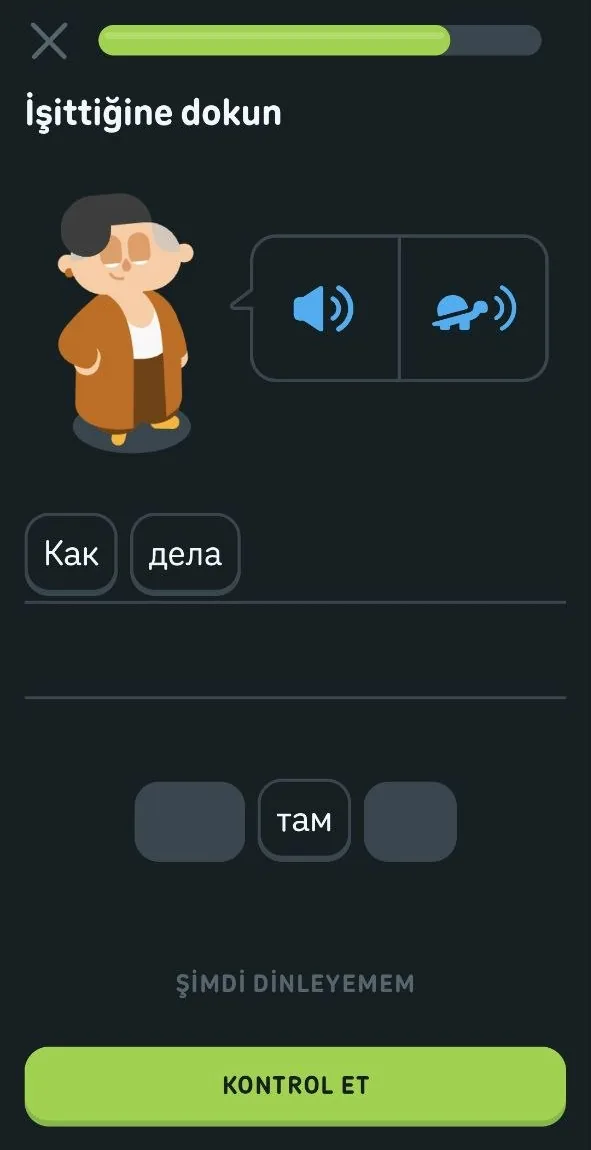
The AI side is Video Call, where you talk to the character Lily. In 2026 Duolingo started moving Video Call into the cheaper Super plan and stopped selling Max to new subscribers [4]. That makes it easier to try, but the calls are short and stay close to the course.
The honest problem is the gap between tapping and talking. You can finish a whole unit by picking the right tiles, and still not be able to say the sentence out loud without help. On day nine of our Spanish streak we had finished the whole restaurant unit, then tried to order out loud with no tiles on screen. We got stuck on ¿Me trae la cuenta?, a sentence we had tapped a dozen times that week and never once said. The free plan also has ads and an energy limit that many learners find annoying [1].
What Speak is like
Speak started as an English app in Korea and now also teaches Spanish, French, Japanese, Korean, Italian and Mandarin to English speakers [7]. The idea is simple: you say every sentence out loud, from the first lesson. Our first Japanese lesson had us introducing ourselves within two minutes, and the app made us repeat arigatō gozaimasu until the long vowel was actually long. It felt slow that evening. By the third lesson we were answering without reading the screen first.

A lesson moves from short phrases you repeat, to guided practice, to a roleplay where you use the new phrases in a small scene. You can ask the Speak Tutor a question when you get stuck, and Smart Review brings back what you practised [7].
The weak spots are price and range. Speak Premium costs well above Duolingo Super, there is no free plan beyond the trial, and reviewers note that roleplays stay at a similar level after the first months [8]. If your language is not one of its seven, it is not an option at all.
Speaking: Speak clearly wins here
If the only question is how much you get to talk, Speak beats Duolingo easily. A Speak lesson is mostly you speaking. A Duolingo lesson is mostly you tapping, with speaking as an extra.
Duolingo's Video Call is fun and a good first step, but it is short and stays close to what the course already taught. Speak puts your voice at the centre of every lesson, then asks you to use the same phrases in a roleplay. That has a practical side: on a crowded bus, Speak is hard to use because every step wants your voice. We ended up doing Duolingo on the commute and saving Speak for evenings at home.
What neither does well is open, long conversation. Speak's roleplays follow the lesson, and Duolingo's calls stay small. Learners at a higher level may want more freedom than either gives.
Lessons and grammar
Both apps have a real course, and both teach grammar mostly through examples rather than long explanations.
Duolingo's course is longer and goes further in popular languages like Spanish and French. Units build on each other and you always know what is next. The catch is that it teaches by guessing more than by explaining, and the course is the same for everyone.
Speak's course is shorter but more practical. Each lesson is built around something you would actually say, like ordering food or talking about your work. When a rule is unclear, you can ask the tutor, which Duolingo cannot really match.
Pronunciation and feedback
Duolingo listens to you in speaking exercises, but it mostly checks whether it heard the right words. You get little help on how you said them, and many learners simply turn speaking exercises off.
Speak listens to every answer and points out what to fix, and its Pronunciation Coach helps with sounds that are hard for you. It is not perfect. Some reviewers find the speech check too forgiving, so a wrong sound can pass [8]. Still, you get far more feedback on your voice than in Duolingo.
Feature by feature
✓Yes◐Partly✕No
| Feature | Duolingo | Speak |
|---|---|---|
| Free to start | ✓ | ◐7-day trial |
| Every lesson spoken out loud | ✕ | ✓ |
| Speak with an AI tutor | ◐short Video Calls | ✓ |
| Feedback on pronunciation | ◐basic | ✓ |
| Game features and streaks | ✓ | ◐light |
| Review of what you learn | ◐practice sessions | ✓Smart Review |
| Works on the web | ✓ | ◐mostly phone apps |
| Number of languages | ✓40+ | ◐7 |
Duolingo is the wider app, with more languages, a free tier and a web version. Speak does fewer things, but the one it does, getting you to speak, it does much better.
Price and plans
| Plan | Duolingo | Speak |
|---|---|---|
| Free option | Yes, with ads and an energy limit | 7-day free trial |
| Monthly | About 10 to 13 dollars (Super) | About 18 dollars (Premium), about 40 (Premium Plus) |
| Yearly | About 84 to 120 dollars | About 84 dollars (Premium), about 165 (Premium Plus) |
| Platforms | iPhone, Android, web | iPhone, Android |
Prices are US App Store prices checked in September 2026 [1][5]. They vary by country and by offer, so check the price in your own store before you pay. Speak renews on its own after the trial, so set a reminder.
Who should pick which
Pick Duolingo if you are starting from zero, you want something free or cheap, or your language is not one Speak teaches. It is still the best habit builder there is.
Pick Speak if you learn English, Spanish, French, Japanese, Korean, Italian or Mandarin, and your main problem is freezing when you speak. The extra cost buys you real speaking time in every lesson.
Conclusion
Duolingo and Speak are both good at one thing. Duolingo gets you to open the app every day, and Speak gets you to open your mouth. If you are new, on a budget or learning a less common language, start with Duolingo. If you learn one of Speak's seven languages and freeze when you speak, Speak is the better use of your time. Some learners keep a Duolingo streak for words and add Speak for talking.
If neither app fits, see our Duolingo alternatives and Speak alternatives, compare Airlearn vs Duolingo or Duolingo vs Praktika, or browse the best AI language learning apps.
Frequently asked questions
Is Speak better than Duolingo for speaking?
Yes. In Speak you say every sentence out loud and use it in a roleplay, while Duolingo is mostly tapping, with short Video Calls as an extra. For habit, price and language choice, Duolingo is stronger.
Is Speak worth it if Duolingo is free?
It is if your main goal is to speak and you practise most days. If you mainly want a light daily habit or you are not sure you will stick with it, start with free Duolingo.
Does Speak teach the same languages as Duolingo?
No. Speak teaches English, plus Spanish, French, Japanese, Korean, Italian and Mandarin for English speakers. Duolingo offers more than 40 languages.
Can I use Duolingo and Speak together?
Yes, and it works well. Use Duolingo for a short daily lesson and Speak a few times a week to say the same kind of things out loud. Just check you are not paying for two plans you do not use.
Sources
- Duolingo on the App Store plans, prices and ratings
- Duolingo on Google Play rating and downloads
- Duolingo (2026). Q2 2026 shareholder letter daily active users
- The Motley Fool (2026). Duolingo Max changes Max and Video Call changes
- Speak on the App Store plans, prices and ratings
- Speak on Google Play rating and downloads
- Speak official site languages, plans and downloads
- Languatalk (2026). Speak review limits at higher levels