
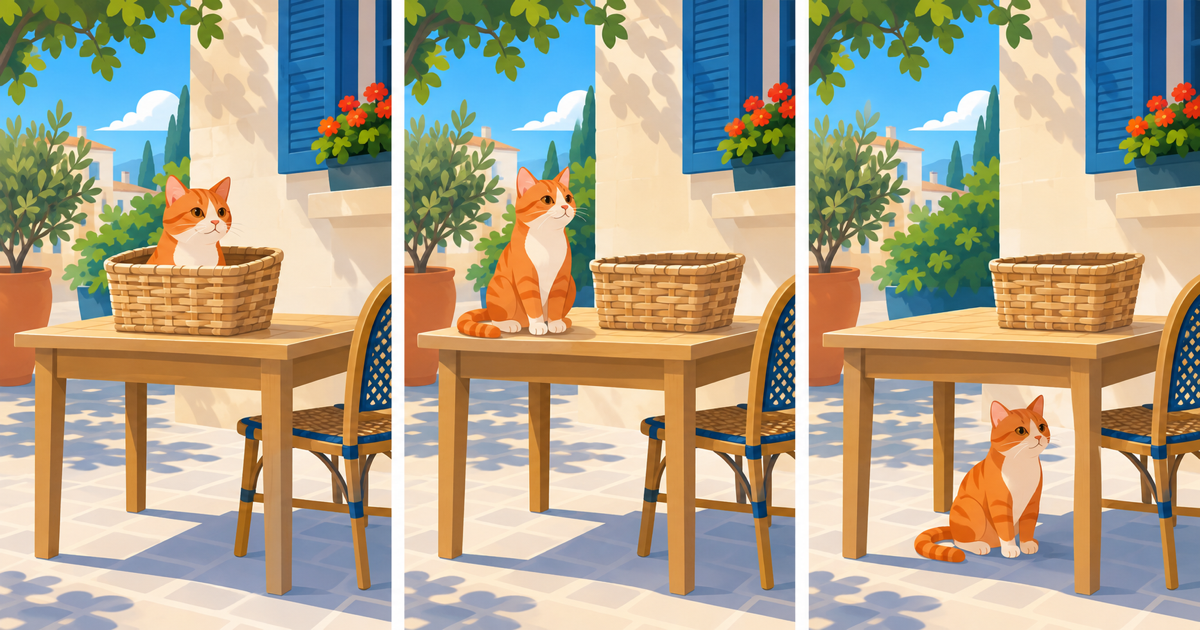
You say in May, on Monday and at six. You also say in London, on the bus and at the door. The three words look random until you see the picture behind them.
Think of size. In is a container you are inside. On is a surface or a line you touch. At is a point you meet. That picture works for both time and place, and it sits at A2 to B1 level [1].
Once you hold that picture, most choices feel natural. You still need the fixed phrases, because English keeps a few. You also need the zero rule, where you use no word at all. This page gives you the picture, then the time rules, then the place rules, then the exceptions that catch you.
Picture a box, a top and a dot
Keep one image in your head and test every sentence against it. In means inside borders. On means touching a flat thing or following a line. At means a dot on a map or a dot on a clock.
The same idea covers time. A month is a long box you live inside, so you say in May. A day is a surface you stand on, so you say on Monday. A clock time is a sharp point, so you say at six.
Use the picture before you use memory. Ask yourself what you are picturing. If you picture walls around you, pick in. If you picture ground under you, pick on. If you picture a pin on a plan, pick at.
- in the kitchen, in London, in winter. You are inside a room, a city or a season. The borders hold you.
- on the table, on the wall, on Monday. You touch a surface or you stand on one named day.
- at the door, at work, at six. You meet a point in space or a point in time. No inside, no surface.
Time grows from point to box
Time with at is short and sharp. You use it for clock times and for a few fixed points. Say at six, at noon, at midnight and at night. You also say at the weekend in British English. American English says on the weekend. Cambridge exams expect the British form.
Time with on is one day long. You use it for days and dates. Say on Monday, on Tuesday morning, on 12 June and on my birthday. The day can have a morning or evening with it, but the day still controls the word. You say on Friday night, not in Friday night.
Time with in is long. You use it for months, years, seasons and parts of the day. Say in May, in 2019, in winter, in the morning and in the evening. The one exception is at night, not in the night. Learn that pair as it is.
| At point | On day | In stretch |
|---|---|---|
| at six, at noon, at midnight | on Monday, on Friday | in May, in 2019 |
| at night, at Christmas, at Easter | on 12 June, on Christmas Day | in winter, in summer |
| at the weekend in British use | on my birthday, on Tuesday morning | in the morning, in the evening |
Place shrinks from box to point
Place works the same way, but in reverse. In is the biggest space. You are inside it. Say in the kitchen, in London, in France and in bed. You also say in the corner when you mean inside a room. You picture walls.
On means contact. You touch a surface or you follow a line. Say on the table, on the wall, on the floor and on the second floor. You also say on the corner when you mean the outside edge of a street. You picture your feet or your back against something.
At is the smallest idea. It is a point where you do something. Say at the door, at work, at school and at 15 Oxford Street. You do not picture the building from inside. You picture the address as a dot where you meet someone.
| In inside | On touching | At point |
|---|---|---|
| in the kitchen, in London | on the table, on the wall | at the door, at work |
| in the park, in a taxi | on the second floor, on a street | at 15 Oxford Street, at home |
✦ Test yourself
Check the picture
Five quick choices with answers
I will see you ___ Monday.
She was born ___ 2019.
We met ___ six ___ the evening.
Your keys are ___ the table.
I waited ___ the door for ten minutes.
Slova turns the ones you missed into a ten-minute lesson, in sentences about your own week.
Practise this in Slova →Same corner, three pictures
One noun can take all three words. The word tells your listener what you picture. The corner is the clearest case. Learn it and you will feel the difference everywhere else.
Look at the three sentences. Only the preposition changes. The grammar is the same each time. The meaning moves from inside to edge to meeting point.
Same place, three pictures. Watch the preposition and what it does.
She waited in the corner of the room.
In pictures walls. She is inside the room, tucked into the angle where two walls meet.
He stood on the corner of the street.
On pictures a surface or line. He is outside on the pavement, at the edge where two streets meet.
I will meet you at the corner.
At pictures a dot. You do not care about inside or surface, only the meeting point you both can find.
containersurfacepoint
Ride on big transport, in small cars
Transport follows the same picture, with one twist. You say on the bus, on the train, on the plane and on the ferry. You can stand and walk inside them, so you picture a long floor under you. You also say on a bike and on a horse. You sit on top of them.
You say in a car, in a taxi and in a van. You cannot stand up in them, so you picture a small box around you. You say in the back seat for the same reason. Do not say on a car unless you are sitting on its roof.
A few at phrases act like points in your day. Say at work, at school, at home and at university. You mean the place as a point where you do something, not the building itself. If you mean inside the building, switch back. You work at school, but the desks are in school.
Drop the word before next, last and every
Some time phrases take no preposition at all. You use a bare word. Say next week, last year, this morning, every day and tomorrow. Do not add in, on or at in front of them. You say I will see you next week, not in next week.
This rule beats the day rule. Monday alone takes on, but next Monday and last Monday take nothing. You say on Monday, but you say I saw her last Monday. The words next, last, this and every already point, so you need no extra word.
British and American use also splits one phrase. British use says at the weekend. American use says on the weekend. Both are correct in their place, but do not mix them into in the weekend. If you take an international exam, write at the weekend.
Fix five small slips first
These five slips mark you out fast. Each one breaks the picture above. Fix them and most of your sentences will land right.
Read each pair out loud. Say the wrong one, then the right one. Your ear will learn the pattern faster than your eye. Keep the picture in mind as you speak.
- Do not say in Monday or on May. Days take on and months take in. Say on Monday and in May. The day is a surface, the month is a box.
- Do not say in the weekend. British use says at the weekend and American use says on the weekend. Pick the one for your listener. For exams, use at the weekend.
- Do not add a word before next, last, this and every. Say next week, last year, this morning and every day. No in, on or at comes first.
- Do not say in a bus or in a plane. Big transport takes on. Say on the bus and on the plane. Keep in for in a car and in a taxi.
- Do not say at the morning. Parts of the day take in, except night. Say in the morning and in the evening, but at night.
Still mixing on Monday and in May? Tell Slova and it will build you a short path on this contrast, with correction as you speak.
Build a mini path →Conclusion
Hold the picture and the words stop feeling random. In puts you inside a box of time or space. On puts you on a day, a surface or a line. At puts you on a point you can meet. Practise with your own week. Say where you will be on Friday, in the evening and at noon, and let someone correct the picture when it slips.
Frequently asked questions
Why do you say on Monday but in May?
Monday is one day, so you picture a surface you stand on. May is a whole month, so you picture a box you live inside. Day takes on, long stretch takes in.
Is it at the weekend or on the weekend?
British English uses at the weekend. American English uses on the weekend. Both are correct. International exams usually expect at the weekend.
Why is it on the bus but in a car?
You can stand and walk on a bus, train or plane, so you picture a floor. You sit boxed in a car or taxi, so you picture walls. Size and movement decide.
When do you use no preposition at all?
Use nothing before next, last, this and every, and before tomorrow, today and yesterday. Say next week, last year, this morning and every day.
Sources
- Council of Europe. Common European Framework of Reference for Languages: level descriptions. where this contrast sits in the A2-B1 range
- Dunlosky, J., Rawson, K. A., Marsh, E. J., Nathan, M. J., & Willingham, D. T. (2013). Improving students' learning with effective learning techniques. Psychological Science in the Public Interest, 14(1), 4-58. practice testing and spaced review rated high utility